
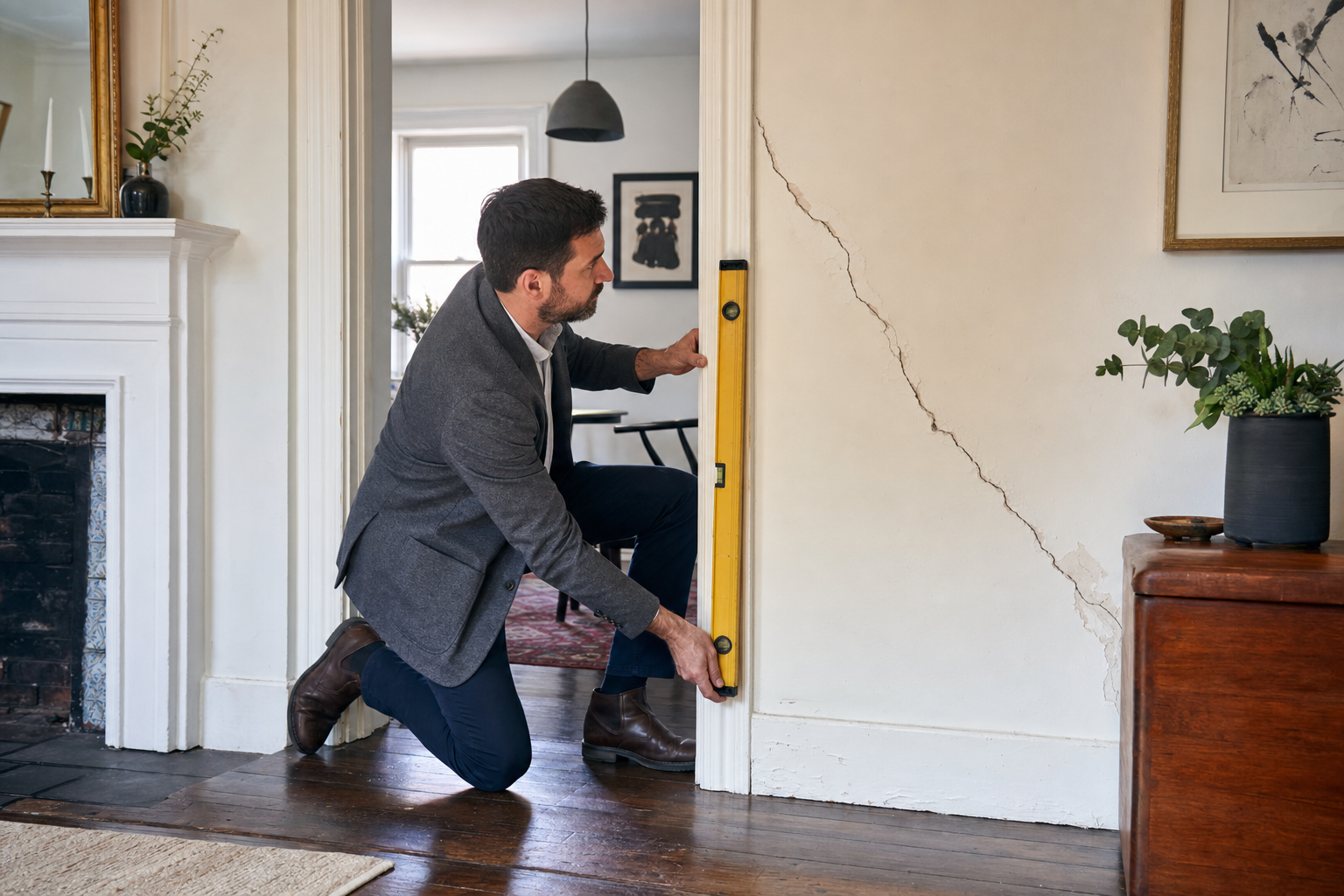
What Are the Signs of Structural Damage in a House?
Table of Contents
- Why Structural Damage Signs Matter
- Exterior Warning Signs
- Interior Warning Signs in Walls and Ceilings
- Floor and Foundation Warning Signs
- Signs of Previous Unpermitted Structural Work
- How Serious Is It? A Quick Severity Guide
- Toronto-Specific Considerations
- What to Do Next
- When to Call a Structural Engineer
- Frequently Asked Questions
Why Structural Damage Signs Matter
Structural damage rarely announces itself loudly. Most signs appear gradually, a crack that widens over months, a floor that slowly loses its levelness, a door that starts sticking in summer and never quite recovers. By the time the damage is obvious, the underlying cause has often been developing for years. Recognizing early warning signs in your Toronto home allows you to get engineering assessment and address issues before they become significantly more expensive and complex to repair.
Key Takeaways
- Most structural damage signs develop gradually and are easy to dismiss or defer.
- Certain signs, horizontal foundation cracks, bowing walls, sagging rooflines, require prompt engineering assessment.
- Many warning signs in Toronto homes relate to the age and construction type of the property.
- A structural engineer's assessment is the only reliable way to determine whether a sign indicates a serious problem or a manageable condition.
Exterior Warning Signs
Foundation cracks visible from outside: Diagonal or horizontal cracks in the exposed foundation above grade, or visible through basement window wells, warrant investigation. See What Causes Foundation Cracks in Toronto Homes? for a discussion of causes.
Bowing or leaning walls: Any wall, foundation or main floor, that is visibly not plumb, or that appears to lean or bow inward, indicates lateral loading or structural movement.
Sagging or uneven roofline: A ridge that dips at mid-span, a visible wave in the roof surface, or fascia boards that are not level across the front of the house all suggest roof framing distress.
Sticking or out-of-square exterior doors and windows: Frames that are visibly out of square signal differential settlement or structural movement that has racked the building frame.
Stepped or separated stoops: A porch or stoop that has pulled away from the house or settled at a different rate than the main structure suggests independent foundation movement.
Interior Warning Signs in Walls and Ceilings
Diagonal cracks at door and window corners: These are classic signs of differential settlement. They appear as 45-degree cracks radiating from the corners of openings and are most common in plaster and older drywall finishes.
Long cracks running from ceiling corners toward the centre of a wall or ceiling: These often follow lines of stress redistribution from settlement or load path changes.
Visible gaps at wall-ceiling or wall-floor junctions: Gaps that appear at the intersection of walls and ceilings, or between baseboards and floors, indicate relative movement between structural elements.
Walls that are visibly bowed or not plumb: Walls that bow outward at mid-height or are clearly not vertical have been displaced from their original position.
Evidence of past repairs: Large areas of patched plaster or drywall, particularly with subtle texture differences, can indicate previous cracking that was cosmetically repaired rather than structurally addressed.
Floor and Foundation Warning Signs
Sloping or uneven floors: Floors that roll noticeably when walked across, or where furniture tends to shift toward one corner, indicate framing deflection or differential settlement below.
Bouncy or springy floors: Excessive bounce in a floor system usually means joists are undersized for the span, damaged, or have lost their bearing at the supports.
Horizontal cracks in basement walls: The most urgent structural warning sign in a basement. Any horizontal crack with accompanying inward deflection of the foundation wall requires immediate engineering assessment.
Offset cracks (one face displaced from the other): A crack where one side has moved relative to the other indicates active structural movement, not just shrinkage.
Active water infiltration through cracks: Water entering through foundation cracks indicates both a waterproofing problem and a crack that is open enough to allow penetration, worth assessing structurally as well.
See Can a Structural Engineer Inspect Foundation Cracks in Toronto Homes? for the inspection process.
Signs of Previous Unpermitted Structural Work
Informal beams or posts: A beam or post that appears recently installed but with rough framing details may indicate a wall was removed without permits.
Large openings with no visible beam above: Wide openings in walls that show no visible beam or header above are a red flag, either the beam is very well concealed or it was not installed.
Inconsistent floor framing directions or heights: Areas where the floor framing direction changes unexpectedly, or step-downs appear without an obvious design reason, can indicate previous structural alteration.
How Serious Is It? A Quick Severity Guide
| Sign | Typical Urgency |
|---|---|
| Hairline vertical foundation crack | Monitor |
| Diagonal crack at door or window corner | Engineering assessment within weeks |
| Wide vertical crack (over 6 mm) with offset | Engineering assessment promptly |
| Horizontal foundation crack with bowing | Engineering assessment immediately |
| Sagging roofline or floor | Engineering assessment promptly |
| Bowing foundation wall | Engineering assessment immediately |
This table provides general guidance only. Any structural concern that is progressing rapidly warrants prompt professional assessment regardless of type.
Toronto-Specific Considerations
Toronto's clay-heavy soils and freeze-thaw climate produce structural damage patterns that are specific to the region. Seasonal soil movement is a primary driver of foundation cracking and floor settlement in older Toronto homes. Pre-1960 homes in established neighbourhoods are particularly prone to the full range of warning signs described above. If your home is more than 50 years old and you have never had a structural inspection, a baseline assessment is a worthwhile investment before beginning any renovation.
What to Do Next
- Document visible signs with photographs and dates as a baseline.
- Monitor for any change over weeks to months.
- If any sign falls into the "prompt" or "immediate" category above, book an engineering assessment.
- Do not cosmetically repair signs of structural damage before getting an engineering assessment, repairs can obscure evidence of active movement.
When to Call a Structural Engineer
Call a structural engineer immediately for any horizontal foundation crack with bowing, any bowing wall, or any sign that appears to be actively progressing. Call within a few weeks for diagonal cracking, wide vertical cracks with offset, sagging floors, or sagging rooflines. Call before any renovation on a pre-1960 Toronto home as a precaution.
Frequently Asked Questions
Q: Does a diagonal crack at a door corner always mean serious structural damage?
Not always. Diagonal cracks at corners are extremely common in Toronto homes and often reflect cosmetic plaster or drywall cracking from normal seasonal movement. Their significance depends on width, depth, whether they are active, and what else is occurring in the building. An engineer can assess severity accurately.
Q: Should I repair structural damage signs before selling my Toronto home?
Get an engineering assessment first. Some conditions should be repaired before listing; others are better disclosed with an engineering report than cosmetically patched. Undisclosed known defects are a legal liability.
Q: What causes floors to slope in older Toronto homes?
The most common causes are differential settlement of the foundation, deflection in undersized beams or joists, or deterioration of framing members at bearing points. An engineer can identify the specific cause during a structural inspection.
Q: How do I know if a crack in my Toronto home is getting worse?
Mark the ends of the crack with a pencil and date it. Measure the width at several points. Check back in four to eight weeks and compare. A structural engineer can install crack monitors for a more precise record.
Q: Can structural damage be repaired without rebuilding the affected section?
Often, yes. Most structural damage in residential Toronto homes can be repaired with targeted engineering solutions rather than full reconstruction. The engineer's report will specify the appropriate repair scope.
Seeing warning signs in your Toronto home? Get My Free Quote for a professional structural assessment.