Do I Need a Structural Engineer for a Second-Story Addition in Toronto?
Table of Contents
- Yes, A Second-Storey Addition Requires Full Structural Engineering
- Why Second-Storey Additions Are Structurally Complex
- The Structural Engineer's Assessment of the Existing Structure
- New Framing, Connections, and Structural Drawings
- The Permit Process for a Second-Storey Addition in Toronto
- Toronto-Specific Considerations
- What to Do Next
- When to Call a Structural Engineer
- Frequently Asked Questions
Yes, A Second-Storey Addition Requires Full Structural Engineering
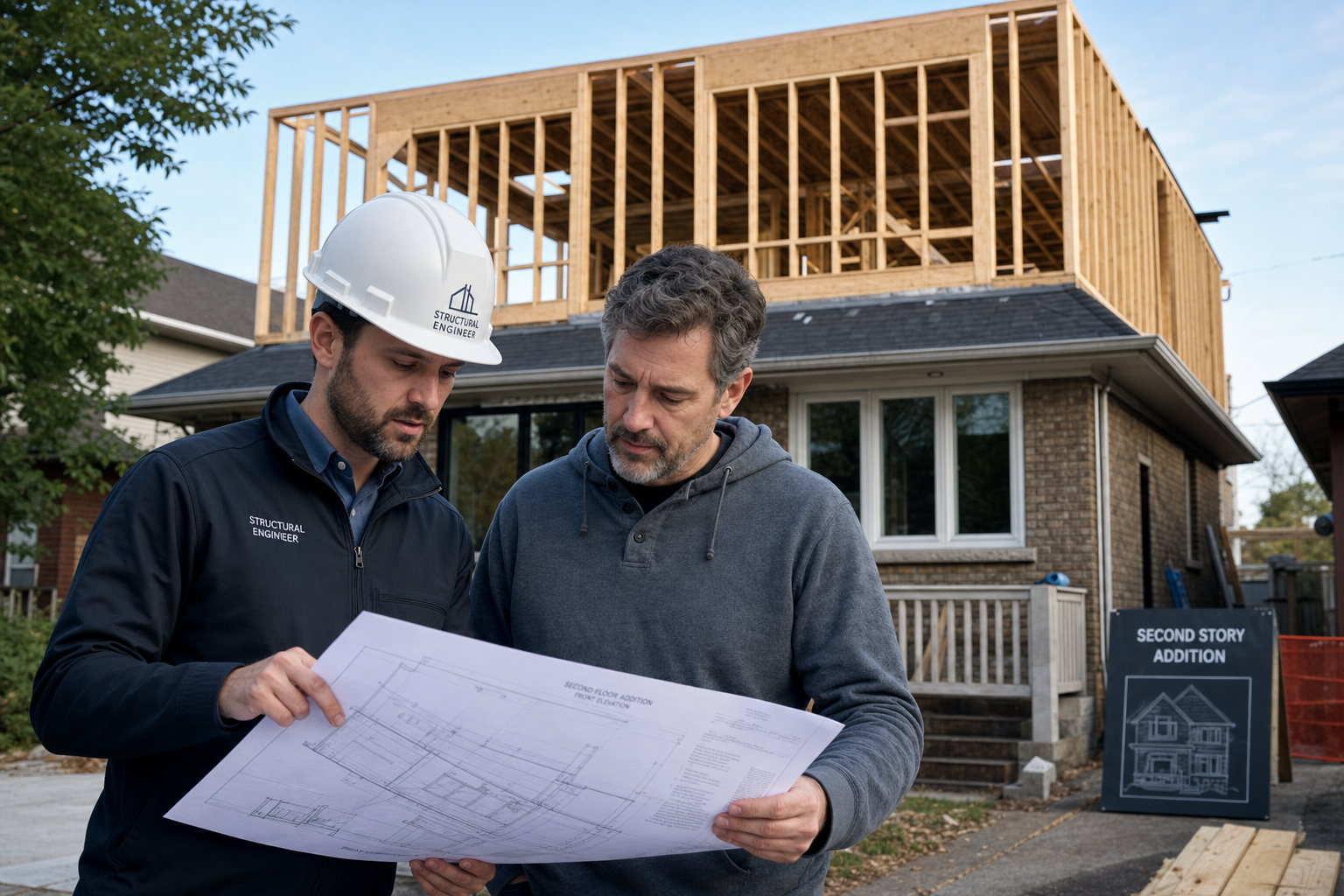
A second-storey addition in Toronto requires a structural engineer, and the engineering scope is more involved than a typical single-storey addition or wall removal. The project adds an entirely new floor level on top of an existing single-storey structure that was originally designed to carry only its own loads. The existing walls, foundations, and footings must be assessed and, in many cases, reinforced to carry the weight of the new storey above. New framing, connections, and structural details must all be engineered and documented in stamped drawings for the building permit.
Key Takeaways
- Second-storey additions require a full structural engineering scope including existing structure assessment, reinforcement design where needed, new framing plans, and connection details.
- Toronto Building requires a building permit with stamped structural drawings for all second-storey additions.
- Existing foundations and walls are frequently insufficient to carry a new storey without some reinforcement.
- Engaging the structural engineer before the architect finalizes the design prevents expensive rework.
Why Second-Storey Additions Are Structurally Complex
A single-storey Toronto home was designed and built to carry its own loads: the roof, the main floor, and occupancy loads. Adding a full second storey introduces a set of new loads that may be two to three times the original design load on the existing walls, foundations, and footings. The structural challenges include:
Increased wall loading: The existing main-floor walls must carry the weight of the new floor framing, new walls, new roof, and all associated occupancy loads. Whether existing studs are adequate for this increase depends on their size, species, grade, and the height of the wall.
Foundation and footing adequacy: The existing footings were sized for a single storey. Adding a storey roughly doubles the loads arriving at the footing. In many Toronto homes, existing footings need to be supplemented with new underpinning sections or deeper footings to handle this increase.
Lateral load resistance: A two-storey structure has greater height and catches more wind load than a one-storey structure. The engineer designs a shearwall system in the new and existing structure to resist this lateral load.
Existing framing condition: In older Toronto homes, the existing framing may be deteriorated, undersized for current standards, or have modifications that affect its capacity. The engineer identifies and addresses these conditions.
The Structural Engineer's Assessment of the Existing Structure
Before designing the new storey, the engineer assesses:
Foundation and footing conditions: Can the existing footings carry twice the load? The engineer reviews footing dimensions (from drawings if available, or by excavating small test pits) and calculates whether they are adequate for the new combined load.
Existing wall framing: Stud size, species, grade, and height are assessed for adequacy under the new loads. In many pre-1960 Toronto homes, existing studs are undersized for the loads a second storey imposes.
Existing floor framing: The first-floor ceiling, which becomes the second-floor floor, may need to be assessed for the loads of the new storey above.
Load path continuity: The engineer confirms that loads can travel continuously from the new second-floor roof, through the new walls, through the existing main-floor walls, through the foundation, and to the footings without interruption.
See structural inspections for how this assessment is conducted.
New Framing, Connections, and Structural Drawings
The structural drawings for a second-storey addition typically include:
- Existing structure assessment notes: Documenting findings and any required reinforcement of the existing structure
- New floor framing plan: Joists, beams, and any special conditions at the interface between old and new
- New wall framing notes: Stud sizing for the new second-storey walls
- New roof framing plan: Rafters, ridge, and any special conditions at dormers or roof changes
- Shearwall layout: Locations and specifications for engineered shearwall panels providing lateral resistance
- Connection details: How the new structure connects to the existing at the storey interface, including straps, anchor bolts, and hold-down hardware
- Foundation reinforcement details (where required)
See structural drawings for what a complete permit-ready package includes.
The Permit Process for a Second-Storey Addition in Toronto
Toronto Building requires a building permit for all second-storey additions. The permit package includes architectural drawings showing the proposed design, stamped structural drawings, a site plan, and the permit application form. For additions that require a zoning variance (exceeding permitted building height, massing, or setbacks), Committee of Adjustment approval must be obtained before a building permit is issued.
Homeowners should confirm permit and zoning requirements with Toronto Building or their design team before committing to a specific design. See Do I Need a Structural Engineer for Permits in Toronto? for the full permit context.
Toronto-Specific Considerations
Toronto's established neighbourhoods have specific zoning controls on building height and massing that affect what second-storey additions are permissible. The city's Neighbourhoods designation in the Official Plan restricts the scale of residential intensification in many areas, which may limit the size of addition that is approved as-of-right. Confirm zoning permissions with Toronto Planning or a design professional before investing in detailed engineering.
Toronto's narrow lots and semi-detached homes also create specific structural challenges for second-storey additions, particularly in managing the interface with the shared party wall, ensuring fire separation at the property line, and managing wind loads on a taller structure in a constrained urban lot.
What to Do Next
- Confirm zoning permissions for your proposed second-storey addition with Toronto Planning before investing in detailed design.
- Engage a structural engineer at the same time as, or before, engaging an architect, their input shapes the design, not just the documentation.
- Plan for the existing structure assessment to be completed before the new design is finalized.
- Budget for foundation or wall reinforcement work as part of the project, it is common on Toronto second-storey additions.
When to Call a Structural Engineer
Call a structural engineer at the conceptual design stage, before finalizing the design with your architect. The engineer's assessment of existing structural capacity directly influences what the addition can look like and how much reinforcement will be needed.
Frequently Asked Questions
Q: Can any Toronto single-storey home support a second storey?
Most can with appropriate engineering and reinforcement. Some homes with very compromised foundations or structural conditions may require more extensive work than others. The feasibility assessment by the structural engineer at the start of the project answers this question for your specific property.
Q: How much does structural engineering for a second-storey addition cost in Toronto?
The scope is more involved than a simple wall removal, reflecting the existing structure assessment, reinforcement design where needed, and full new framing drawings. Request a free quote for project-specific pricing.
Q: Do I need to move out during a second-storey addition in Toronto?
This is a construction management question rather than a structural engineering one, but it is worth discussing with your contractor. Many Toronto homeowners remain in the home during phased second-storey additions with appropriate weather protection in place.
Q: How long does a second-storey addition permit take in Toronto?
From full engineering and architectural drawings to issued permit, allow two to four months or more depending on Toronto Building's current processing times and whether any zoning variances are needed. Check Toronto Building's website for current estimates.
Q: Will a second-storey addition require new footings at my Toronto home?
Often, yes. Existing footings sized for one storey frequently need supplementing when a second storey is added. The structural engineer confirms this during the existing structure assessment phase and designs any required footing reinforcement or additions.
Planning a second-storey addition in Toronto? Get My Free Quote from Toronto Structural Engineers, engineering and permits done right.