
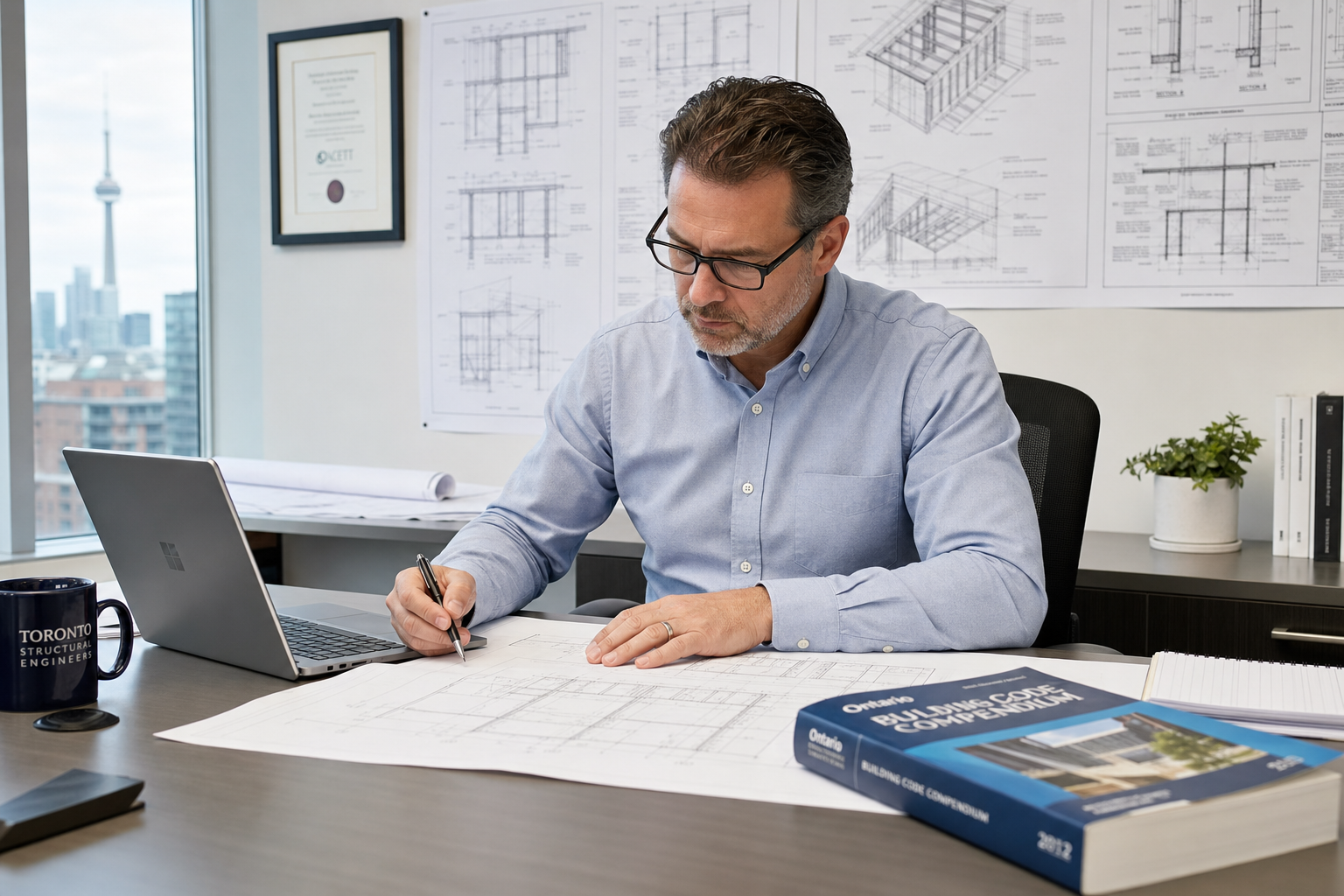
Can a Structural Engineer Help With Building Code Compliance in Toronto?
Table of Contents
- What Building Code Compliance Means for Toronto Homeowners
- How Structural Engineers Apply the Ontario Building Code
- OBC Part 9 vs. Part 4: What the Difference Means for Your Project
- Code Compliance at Each Project Stage
- When Existing Conditions Are Not Code-Compliant
- Toronto-Specific Considerations
- What to Do Next
- When to Call a Structural Engineer
- Frequently Asked Questions
What Building Code Compliance Means for Toronto Homeowners
Yes, a structural engineer is one of the primary professionals responsible for ensuring that residential construction and renovation in Toronto meets the Ontario Building Code (OBC). Building code compliance is not simply a checkbox at the end of a project, it is an ongoing engineering responsibility that runs from design through permit submission, construction, and inspection sign-off. The engineer's stamp on structural drawings is, in part, a professional declaration that the design meets applicable OBC requirements. Without that stamp, Toronto Building will not issue a permit for structural work.
Key Takeaways
- Structural engineers apply Ontario Building Code requirements directly in every structural design.
- The OBC sets minimum standards for structural loads, framing, foundations, and connections.
- Engineers working in Toronto must reference the current OBC edition and meet Toronto-specific requirements layered on top.
- Code compliance protects homeowners from safety risks, permit rejection, and legal liability.
How Structural Engineers Apply the Ontario Building Code
The OBC is the primary technical reference for every design decision a structural engineer makes on a residential project in Ontario. When sizing a beam, the engineer applies the load, span, and deflection criteria from OBC Part 4. When designing a footing, the minimum bearing capacity and frost depth requirements from Part 9 set the baseline. When reviewing a wall, the stud sizing tables in Part 9 define whether the wall needs custom engineering or falls within prescriptive limits.
The engineer's drawings explicitly reference the applicable OBC edition and part numbers for key design requirements. This makes the code basis transparent to Toronto Building's permit reviewers and to city inspectors during construction.
See code compliance for how Toronto Structural Engineers handles code compliance across project types.
OBC Part 9 vs. Part 4: What the Difference Means for Your Project
Part 9, Housing and Small Buildings: Contains prescriptive rules for standard residential construction, span tables, stud tables, footing sizing rules, and minimum dimensions for most elements. Projects that fall within the Part 9 tables can be built without custom engineering calculations, but the tables still reflect OBC code requirements.
Part 4, Structural Design: Applies when a project exceeds Part 9 prescriptive limits or when the engineer chooses to demonstrate compliance through engineering analysis. Most structural renovation projects in Toronto that require permits use Part 4 because the existing conditions and proposed changes fall outside the standard assumptions embedded in Part 9 tables.
Understanding which part applies tells you whether your project can proceed with prescriptive framing or whether engineered design is required.
Code Compliance at Each Project Stage
Design phase: The engineer designs structural elements to meet OBC requirements for loads, spans, deflection, and connections. Non-compliant design is flagged and revised before drawings are finalized.
Permit submission: Stamped drawings reference OBC code basis. Toronto Building's permit reviewers check submitted drawings against OBC requirements. A comment letter identifying non-compliance is returned to the engineer for revision.
During construction: Contractors must build per the stamped drawings. City inspectors confirm at required hold points that the work matches the approved drawings. The engineer responds to any technical questions about drawing intent.
Inspection sign-off and permit closeout: All required inspections are completed and passed, confirming that the built work meets the OBC as documented in the approved stamped drawings.
See Do I Need a Structural Engineer for Permits in Toronto? for the full permit process context.
When Existing Conditions Are Not Code-Compliant
Pre-existing conditions that do not meet current OBC are common in Toronto's older housing stock. The OBC does not generally require that existing elements be upgraded to current standards unless they are directly affected by a renovation. When a renovation does affect an existing element, by adding new loads to it, for example, the engineer assesses whether the element is adequate for those new loads under current code requirements.
If it is not, the engineer designs an upgrade as part of the renovation scope. This is how structural reinforcement of older Toronto homes typically comes about, not as a stand-alone compliance requirement, but as part of the engineering scope for a renovation that loads an existing element. See Do Older Homes in Toronto Need Structural Reinforcement? for a broader discussion.
Toronto-Specific Considerations
The Ontario Building Code is the primary regulatory standard, but Toronto's Municipal Code and zoning by-laws layer additional requirements on top. For structural engineers, the relevant Toronto-specific considerations include heritage property constraints, ravine setback requirements for structural footprints, and Toronto Building's specific submission format and documentation requirements.
Toronto is also subject to the OBC's seismic provisions for Ontario's geographic zone. While Toronto's seismic hazard is relatively low compared to coastal Canadian cities, structural engineers consider the applicable seismic requirements in designs for new buildings and significant additions.
What to Do Next
- Confirm that your project's structural engineering scope explicitly references the current Ontario Building Code edition.
- Ensure your engineer is a PEO-licensed P.Eng. with experience in Toronto residential projects and Toronto Building's submission requirements.
- Review permit drawings for OBC references, these confirm the code basis for your project.
- Do not assume that work done before current code requirements were in place is automatically acceptable for a current renovation. Confirm with your engineer.
When to Call a Structural Engineer
Call a structural engineer when:
- You want confirmation that a proposed renovation meets OBC requirements before investing in construction
- Toronto Building has flagged code compliance issues in a permit submission
- A contractor has proposed structural work that you want independently verified against the OBC
- You are planning a significant renovation in an older Toronto home and want to understand what current code requires
Frequently Asked Questions
Q: What OBC edition currently applies to Toronto building permits?
The OBC is updated periodically. The edition in force at the time a permit is issued generally governs that project. Your engineer will reference the applicable edition on the stamped drawings. Confirm the current edition with Toronto Building or your engineer.
Q: Does the OBC apply to renovation work on my existing Toronto home?
Yes. New work performed under a permit must meet the current OBC. Existing elements not affected by the renovation are generally not required to be upgraded to current standards. Your engineer identifies where the current code applies within your specific renovation scope.
Q: Can a project be "over code"?
Yes. Structural engineers sometimes specify elements beyond the OBC minimum, for improved durability, owner preference, or to accommodate future changes. The OBC sets a floor, not a ceiling, for structural performance.
Q: What is a code-compliant drawing package?
A code-compliant drawing package includes stamped structural drawings that reference the applicable OBC edition, demonstrate that all structural elements meet code requirements for loads, spans, deflection, connections, and material specifications, and are formatted to meet Toronto Building's submission standards. See structural drawings for what this includes.
Q: Is there a way to check if previous work on my Toronto home was code-compliant?
You can request permit records from Toronto Building for your address to confirm what work was permitted. For structural elements, a structural engineer can assess whether visible conditions appear consistent with code requirements, though without opening walls or floors, some elements cannot be directly confirmed.
Want to ensure your Toronto project is fully code-compliant? Get My Free Quote from Toronto Structural Engineers.