
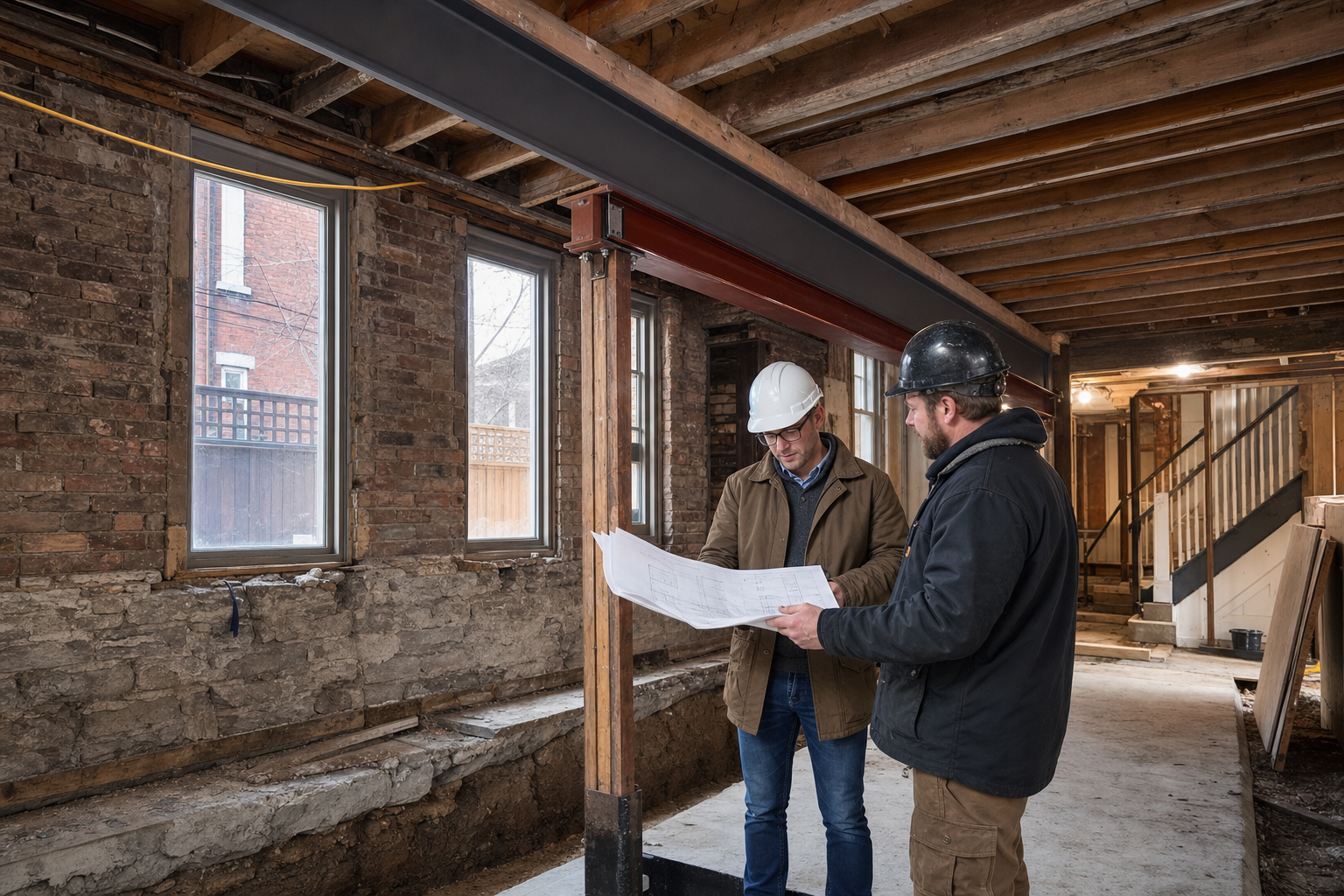
Do Older Homes in Toronto Need Structural Reinforcement?
Table of Contents
- What "Structural Reinforcement" Means for an Older Toronto Home
- Common Structural Deficiencies in Pre-1960 Toronto Homes
- When Reinforcement Is Triggered by a Renovation
- When Reinforcement Is Required for Safety
- Reinforcement Options for Foundations, Framing, and Roofs
- Toronto-Specific Considerations
- What to Do Next
- When to Call a Structural Engineer
- Frequently Asked Questions
What "Structural Reinforcement" Means for an Older Toronto Home
Structural reinforcement means adding or upgrading structural elements in an existing home to bring them to a safe, functional standard, either to meet current code requirements for a planned renovation, or to address deterioration and deficiency that has developed over time. For older Toronto homes, this is a common reality. Buildings constructed before 1960 were built to standards of their era, with materials and framing practices that differ from modern requirements. Many are still performing adequately; others have conditions that a structural engineer should assess before any significant renovation proceeds.
Key Takeaways
- Older Toronto homes do not automatically need reinforcement, but many have conditions that benefit from engineering assessment.
- Reinforcement is most commonly triggered by a renovation that changes loads, or by observed distress (cracking, deflection, deterioration).
- Common reinforcement needs include foundation upgrading, floor framing sistering, beam replacement, and roof framing reinforcement.
- A structural engineer assessment before a major renovation in a pre-1960 Toronto home is a sound precaution.
Common Structural Deficiencies in Pre-1960 Toronto Homes
Undersized floor joists: Pre-war Toronto homes were often framed with smaller lumber sections and shorter span tables than current practice. This results in floors that are technically adequate for occupancy loading but may deflect noticeably and become inadequate if loads are added (tile floors, hot tubs, heavy storage).
Rubble stone and brick foundations without reinforcement: Pre-1920 foundations relied on mass and mortar. They are permeable, subject to mortar deterioration, and cannot be cut or modified the way modern concrete foundations can without specific engineering.
Concrete block (CMU) foundations without core reinforcement: Common in 1940s to 1970s Toronto homes. Without grout-filled and rebar-reinforced cores, these walls have limited resistance to lateral soil pressure.
Unbraced attic framing: Many older Toronto homes have attic rafters without adequate collar ties or ceiling joists providing lateral restraint, which can allow gradual spreading of the exterior walls.
Mixed or deteriorated lumber: Pre-war homes sometimes incorporated mixed lumber species, green lumber, or reused material that may have lower structural capacity than stamped dimensional lumber used in modern construction.
When Reinforcement Is Triggered by a Renovation
Renovation-triggered reinforcement is the most common scenario in Toronto. When a homeowner plans to:
- Remove a load-bearing wall (the new beam loading often reveals undersized footings below)
- Lower the basement floor through underpinning (requires full assessment of existing foundation conditions)
- Add a second storey (existing walls and foundations must carry new loads they were not originally designed for)
- Convert attic space to habitable use (increased floor loading and changed roof loading require framing assessment)
In each of these cases, the engineer assesses the existing structure as part of the design phase and incorporates any required reinforcement into the scope and permit drawings. See Do I Need a Structural Engineer for a Second-Story Addition in Toronto? for how this works in practice.
When Reinforcement Is Required for Safety
Outside of renovation triggers, reinforcement may be needed when:
- Foundation cracks have progressed to indicate active structural movement
- Floor deflection is excessive and progressively worsening
- Visible deterioration (rot, insect damage) has reduced the capacity of framing members
- A structural inspection reveals deficiencies that fall below a safe threshold for continued occupancy
See What Are the Signs of Structural Damage in a House? for the warning signs that trigger this assessment.
Reinforcement Options for Foundations, Framing, and Roofs
Foundation reinforcement: Options include carbon-fibre wall straps for bowing concrete block walls, helical wall anchor systems for lateral wall support, shotcrete lining of deteriorated stone or brick foundations, and underpinning to deepen footings.
Floor framing reinforcement: Sistering new joists alongside existing ones, installing a new mid-span beam to reduce effective spans, and improving bearing conditions at joist ends.
Beam replacement: When an existing beam is undersized or deteriorated, a new LVL or steel beam is installed. See Can a Structural Engineer Design Beams and Support Posts for Home Renovations? for how beam design works.
Roof framing reinforcement: Adding collar ties, sister rafters, ridge beams, or compression struts to arrest spreading and restore adequate lateral restraint.
Toronto-Specific Considerations
Toronto's established residential neighbourhoods contain a significant proportion of pre-1960 housing. These homes hold enormous character and value, and reinforcement work preserves them for future generations without requiring demolition or full reconstruction. Engineers experienced in Toronto's older construction types can assess these homes accurately, distinguishing conditions that need urgent attention from those that have been stable for decades and can be managed with monitoring.
Heritage properties in Toronto require that reinforcement work be compatible with the property's heritage character. Structural reinforcement is generally supported by Heritage Preservation Services where it is interior work that does not affect heritage attributes, confirm project-specific heritage requirements with the City of Toronto.
What to Do Next
- If your Toronto home was built before 1960 and you are planning a major renovation, book a structural assessment before finalizing the design scope.
- If you have observed any of the warning signs described in this article, have them assessed by a structural engineer before proceeding with any renovation work.
- Obtain stamped drawings for any reinforcement work that requires a permit.
- Do not assume your older Toronto home does not have structural deficiencies simply because it has been standing for 80 or 100 years.
When to Call a Structural Engineer
Call a structural engineer for an older Toronto home when:
- You are planning any major renovation in a home built before 1960
- You have observed deterioration, deflection, or cracking that may indicate framing or foundation deficiency
- A home inspector has recommended structural assessment
- You want a baseline structural assessment before purchasing or significantly renovating an older Toronto property
Frequently Asked Questions
Q: Does an older Toronto home have to be brought up to current OBC standards during a renovation?
The Ontario Building Code generally requires that new work meets current code, but does not require upgrading of existing elements that are not part of the renovation scope. When a renovation triggers assessment of existing elements, because new loads are being applied to them, for example, those elements may need to be upgraded. Your engineer identifies what is and is not in scope.
Q: Is a rubble stone foundation dangerous?
Not inherently. Many rubble stone foundations in Toronto have been performing for over 100 years. Their limitations are permeability, sensitivity to mortar deterioration, and inability to be cut or modified like modern concrete. An engineer can assess whether the condition of the specific foundation is adequate for the intended use.
Q: Can carbon-fibre straps really reinforce a bowing foundation wall?
Yes. Carbon-fibre reinforcement systems (straps bonded to the interior face of the wall) are a proven and widely used repair for bowing concrete block and poured concrete walls, arresting further movement and adding tensile capacity to the wall. They require engineering design for the specific wall condition.
Q: How much does structural reinforcement cost for an older Toronto home?
Costs vary widely depending on what is needed. A simple floor joist sistering project is far less costly than a full foundation reinforcement or underpinning scope. A structural engineer's assessment is the first step to understanding the scope and cost. Request a free quote to start.
Q: Will structural reinforcement increase my Toronto home's value?
Done correctly and with proper permits, structural reinforcement addresses deficiencies that would otherwise require disclosure or price reduction in a sale, effectively protecting the property's value rather than simply adding to it.
Wondering if your older Toronto home needs structural reinforcement? Get My Free Quote for an expert assessment.