
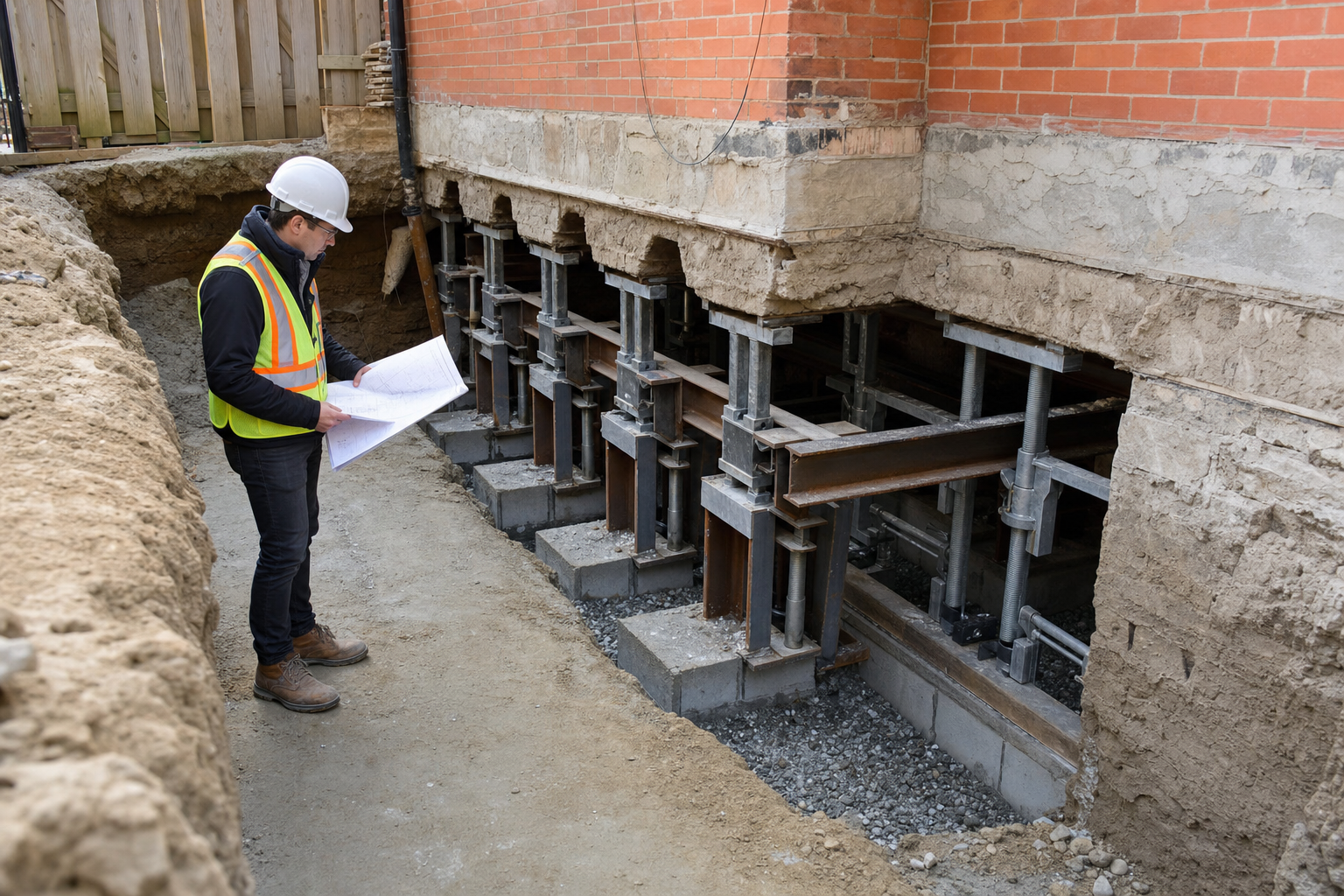
Do I Need a Structural Engineer for Underpinning in Toronto?
Table of Contents
- Yes, Underpinning Always Requires a Structural Engineer
- What the Structural Engineer Does on an Underpinning Project
- The Sequential Underpinning Method
- Permit Requirements for Underpinning in Toronto
- Semi-Detached and Row Homes: Party Wall Engineering
- Toronto-Specific Considerations
- What to Do Next
- When to Call a Structural Engineer
- Frequently Asked Questions
Yes, Underpinning Always Requires a Structural Engineer
Basement underpinning in Toronto requires a structural engineer without exception. No contractor can undertake underpinning legally in Toronto without stamped engineering drawings prepared by a PEO-licensed Professional Engineer. This is not a regulatory technicality, it reflects the genuine structural risk that underpinning creates. The entire weight of the house above is repeatedly transferred to temporary supports while new foundation sections are poured beneath the existing footings. If the excavation sequence, bench geometry, or construction timing deviates from the engineer's design, the risk of structural damage or collapse is real. The engineer's drawings are what prevents that.
Key Takeaways
- Underpinning requires stamped structural engineering drawings, no permit will be issued without them.
- The engineer designs the excavation sequence, bench dimensions, reinforcement, and inspection stages.
- Toronto Building requires on-site inspections at multiple stages throughout the underpinning process.
- For semi-detached and row homes, party wall engineering and a neighbour agreement are also required.
What the Structural Engineer Does on an Underpinning Project
The structural engineer's scope for an underpinning project is comprehensive:
Site assessment: The engineer visits the site, measures the existing foundation, reviews accessible framing above, and assesses soil conditions to the depth of the proposed new footing level.
Load calculations: The engineer calculates the loads carried by the existing foundation wall sections and confirms that the new bench footings, at the lower level, will have adequate bearing capacity in the soil at that depth.
Sequential excavation design: The engineer divides the perimeter into numbered sections and specifies the order in which they are excavated and poured. No two adjacent sections may be open at the same time.
Bench geometry and reinforcement: Each underpinning section is designed as a reinforced concrete bench: the engineer specifies dimensions, rebar size and spacing, and lap splice lengths.
Inspection hold points: The drawings identify stages at which Toronto Building must inspect before construction proceeds, typically before each section's concrete is poured.
New slab design: After the perimeter is underpinned, a new concrete floor slab is poured. The engineer specifies thickness, reinforcement, and subgrade preparation requirements.
See structural foundations and foundation inspections for related engineering services.
The Sequential Underpinning Method
The standard residential underpinning method used in Toronto works as follows:
- The existing basement floor is broken out and removed.
- The perimeter is divided into sections, typically 600 to 900 mm wide.
- Odd-numbered sections are excavated to the new footing level, reinforcement is placed, and concrete is poured and allowed to cure.
- Even-numbered sections are then excavated, reinforced, and poured.
- The full perimeter is now underpinned to the new depth.
- The new concrete floor slab is poured over a prepared granular base.
Toronto Building inspectors attend at specified hold points throughout this sequence. The engineer's drawings document these holds, and the contractor must not proceed past a hold point without the inspection being completed.
Permit Requirements for Underpinning in Toronto
Toronto Building requires a building permit for all basement underpinning. The permit package includes:
- Stamped structural drawings showing the underpinning sequence, bench details, reinforcement, and slab specification
- Geotechnical information (soil bearing capacity at the new footing depth, from test pits or a formal soil report)
- Details of waterproofing and drainage measures
- Architectural drawings showing the proposed use of the underpinned space and the permit application form
Work may not begin before the permit is issued. Homeowners should confirm current permit requirements with Toronto Building or a licensed Professional Engineer, as requirements can vary by project scope.
Semi-Detached and Row Homes: Party Wall Engineering
Most Toronto underpinning projects involve a semi-detached or row home where a shared (party) footing exists on the boundary with the adjacent property. This footing cannot be modified unilaterally. The engineer's scope expands to include:
- Assessment of the shared footing conditions and engineering of the underpinning approach at the party wall interface
- Coordination with the adjacent owner and their structural engineer (where applicable)
- A pre-construction survey documenting existing crack conditions on the adjacent property
- Engineering of the monitoring protocol during construction to detect any unintended movement in the adjacent structure
- A party wall agreement reviewed and signed by both parties (typically with legal advice)
This is standard process in Toronto and is not a reason to avoid underpinning, but it must be planned and budgeted for. See Do I Need Structural Drawings for a Basement Renovation in Toronto? for the broader permit and engineering context.
Toronto-Specific Considerations
Toronto's clay-heavy soils can exhibit movement during excavation adjacent to existing footings, particularly in the deeper zones of larger underpinning projects. An engineer with experience in Toronto's subsurface conditions specifies excavation protection and monitoring measures appropriate to local soil behaviour.
Toronto also has the highest concentration of semi-detached housing of any major Canadian city. Party wall management for underpinning is a routine part of the city's structural engineering practice, and experienced local engineers have established processes for navigating it efficiently and safely.
What to Do Next
- Confirm the desired basement floor level and measure existing ceiling height to determine the required underpinning depth.
- Engage a structural engineer for a feasibility assessment before committing to a contractor or a party wall conversation with your neighbour.
- If the property is semi-detached or a row home, initiate neighbour communication early, the timeline for a party wall agreement is often the longest single item in the pre-construction schedule.
- Obtain a building permit before any excavation begins.
When to Call a Structural Engineer
Call before you accept any contractor quote that does not include engineering drawings, underpinning without engineering drawings is not a compliant or safe option. Also call before signing any party wall agreement: an engineer should review the structural terms before you commit.
Frequently Asked Questions
Q: How much ceiling height can I gain from underpinning my Toronto basement?
The achievable height depends on existing footing depth and soil conditions. Most Toronto homes can achieve 8 to 9 feet (approximately 2.4 to 2.7 m) of finished ceiling height after underpinning. The structural engineer confirms the feasible depth for your specific site.
Q: Does my neighbour have to agree to my underpinning project?
For semi-detached and row homes in Toronto, the neighbour's involvement is both practically and legally necessary when the shared footing is involved. A formal party wall agreement is standard practice.
Q: How long does a Toronto basement underpinning project take from start to finish?
Engineering and permit: allow two to eight weeks depending on complexity and current Toronto Building processing times. Construction: typically four to eight weeks for a standard semi-detached perimeter. Total: plan for three to six months from initial engineering engagement to completed, permitted new slab.
Q: What is the risk of not using a structural engineer for underpinning?
Without engineering, the project cannot be legally permitted, the excavation sequence has no professional basis, and the risk of differential settlement, wall damage, or structural distress to the home and adjacent properties is real. There is no legitimate path to underpinning in Toronto without a structural engineer.
Q: Can I underpin only part of my Toronto basement?
Yes. Partial underpinning, lowering only specific bays, is technically feasible and can be more cost-effective. The engineer designs the partial scope to manage differential settlement between the lowered and un-lowered sections.
Planning basement underpinning in Toronto? Get My Free Quote from Toronto Structural Engineers, engineering first, always.