
Can a Structural Engineer Help With Sagging Floors or Roofs?
Table of Contents
- What Causes Floors and Roofs to Sag
- How a Structural Engineer Diagnoses the Problem
- Engineering Solutions for Sagging Floors
- Engineering Solutions for Sagging Roofs
- When Sagging Becomes a Safety Issue
- Toronto-Specific Considerations
- What to Do Next
- When to Call a Structural Engineer
- Frequently Asked Questions
What Causes Floors and Roofs to Sag
Yes, a structural engineer is precisely the right professional to diagnose and repair sagging floors and roofs. Sagging occurs when a structural member, a floor joist, a beam, a rafter, or a ridge board, deflects more than the code limit under applied loads. This can result from undersized members that were never adequate for the span and loads, deterioration of wood through moisture, rot, or insect damage, overloading from renovation changes (such as a heavy tile floor installed on joists sized for lighter loading), or removal of an intermediate support without proper re-engineering. A structural engineer finds the cause and designs the repair.
Key Takeaways
- Sagging floors and roofs indicate that a structural member is deflecting beyond acceptable limits.
- The cause may be undersizing, deterioration, overload, or loss of support, only engineering analysis identifies which.
- Repair options range from sister joists and new beams to more extensive framing reinforcement.
- A structural engineer provides the stamped drawings required for permit submission where repairs require one.
How a Structural Engineer Diagnoses the Problem
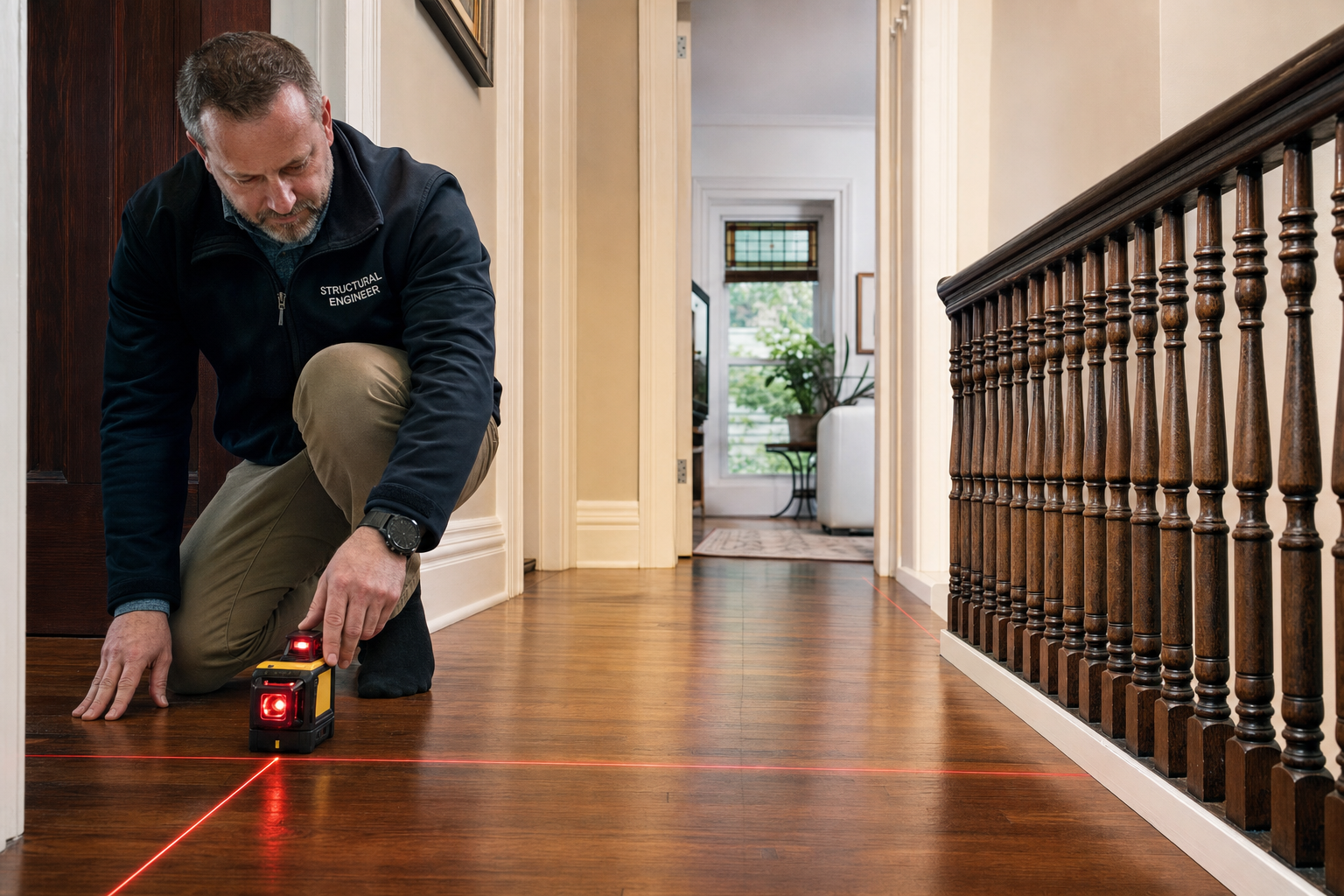
The engineer starts with a site assessment: measuring the degree of sag, identifying the specific member or members responsible, and assessing the condition of the surrounding framing. They review the span, the loads applied above and below, and whether the member was ever adequate or has deteriorated to below its original capacity.
For floor sagging, the engineer checks beam spans and depths, bearing conditions at each end, and whether any modification to the floor system (added weight, removed supports, or altered framing) corresponds to the onset of the problem. For roof sagging, they assess rafter span, ridge member adequacy, collar tie presence and condition, and whether spreading of the exterior walls has reduced the effective support of the roof system.
See structural inspections for how a complete structural assessment is conducted.
Engineering Solutions for Sagging Floors
Sister joists: Attaching a new joist alongside an existing deflected or damaged joist is one of the most common floor repair methods. The sister joist is sized and connected to restore the combined capacity needed for the span.
New or enlarged beam: When a mid-span beam is undersized or deteriorated, the repair often involves installing a new, correctly sized beam. This may be an LVL or steel member depending on the span and loads. See Can a Structural Engineer Design Beams and Support Posts for Home Renovations? for how beam design works.
Additional posts and footings: Where a beam needs more support, new posts are installed, which may in turn require new footings or verification that existing footings can carry the additional concentrated load.
Removal of overload: If the sagging was caused by a renovation-added load (heavy tile, concrete overlay, water-filled hot tub), the engineer may recommend removing the overload as part of or instead of a structural repair.
See structural foundations for footing design considerations when new supports are required.
Engineering Solutions for Sagging Roofs
Ridge beam replacement or addition: A sagging ridge often means the ridge board is acting as a beam without the support needed for that role. The engineer specifies a properly sized ridge beam supported at each end.
Rafter reinforcement: Sister rafters are added alongside deflected originals, or existing rafters are reinforced with a top or bottom plywood gusset.
Collar tie and ceiling joist reinforcement: Adding or reinforcing collar ties at the correct height prevents rafter spread that causes the roof surface to sag at the ridge.
Wall reinforcement: When rafter spread has pushed exterior walls outward, structural straps or ties at the wall-rafter connection arrest further spreading.
When Sagging Becomes a Safety Issue
Most sagging in residential buildings develops slowly and does not represent immediate collapse risk. However, certain conditions require urgent attention:
- Rapid increase in sag over a short period
- Visible cracking, splitting, or separation in the sagging member
- Water damage or rot at bearing points
- Complete loss of a bearing support (post settled into the ground, beam end decayed)
If any of these conditions are present, contact a structural engineer promptly. Do not occupy the space below a rapidly deflecting roof or floor system until an engineer has assessed it.
Toronto-Specific Considerations
Toronto's housing stock includes a high proportion of pre-1960 homes where original framing was sized to standards of the era rather than current OBC requirements. Floor joists in older Toronto homes are frequently undersized by modern standards, and decades of loading have often produced visible deflection even without any single triggering event. Roof systems in these homes commonly used lighter framing than current practice and may show sagging after decades of snow loading.
Renovation work in these homes, adding tile floors, converting attic space to habitable use, or removing interior walls that provided lateral bracing, can accelerate or trigger visible sagging in framing that was already marginal.
What to Do Next
- Document the degree of sag with photographs and measurements.
- Note whether the sag is progressive (getting worse over time) or stable.
- Engage a structural engineer for a site assessment and diagnosis before authorizing any repair work.
- Obtain stamped repair drawings for any structural repair that requires a permit.
When to Call a Structural Engineer
Call a structural engineer promptly if:
- A floor or roof is visibly sagging and the condition appears to be worsening
- You have discovered rot, insect damage, or water damage at framing bearing points
- A renovation is planned in an older Toronto home where existing framing conditions are unknown
- A home inspector or contractor has flagged a sagging condition and recommended further assessment
Frequently Asked Questions
Q: Can a sagging floor be levelled without replacing the floor covering?
Often, yes. Sistering joists or installing a new beam below the existing floor system can reduce deflection without requiring replacement of the floor finish. The extent of the repair depends on the cause and severity of the sag.
Q: Is a sagging floor always a structural emergency?
Not always. Many sagging floors in Toronto homes have been stable for decades. However, a progressive sag, visible member damage, or water infiltration at bearing points escalates the urgency. An engineer can assess which situation you are dealing with.
Q: Do I need a permit to repair a sagging floor in Toronto?
Structural repairs that involve new beams, posts, or footings typically require a permit. Sistering floor joists without other structural changes may not, depending on scope. Confirm with Toronto Building or your structural engineer for your specific repair.
Q: How long does it take to repair a sagging floor?
Physical repair time depends on scope and access. A straightforward sistering repair might take a day or two. Beam replacement or new post and footing installation takes longer. Factor in engineering drawing time and permit processing time before the repair work begins.
Q: Can a structural engineer repair a sagging roof without replacing the whole roof?
Yes. In most cases, targeted reinforcement of the specific members that are deflecting, additional collar ties, sister rafters, or a new ridge beam, is sufficient without a full roof replacement.
Dealing with a sagging floor or roof in your Toronto home? Get My Free Quote for an engineering assessment and repair design.